 4G SIM News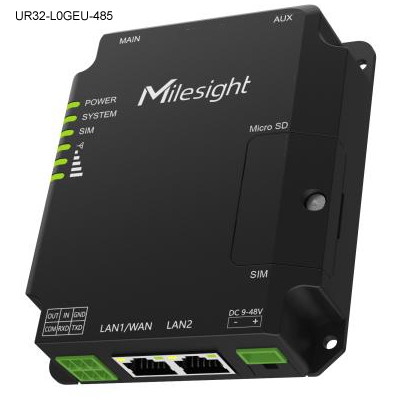
Most industrial connectivity projects fail on one of three things. The router cannot talk to the equipment already on site. The SIM sits behind carrier-grade NAT and nobody can reach the site once it is commissioned. Or the antenna is a stub on a metal cabinet and the signal never had a chance. The hardware is rarely the problem on its own.
The Milesight UR32-L0GEU-485 is a good example of a router chosen to solve the first problem properly. It is the entry model in the UR32 Pro Series, and it is built around a serial port rather than around Wi-Fi. That single decision makes it one of the more useful boxes on the market for telemetry, metering and plant integration. Below is what it does, why it suits those jobs, and why the router is only a third of the answer.
What the UR32-L0GEU-485 actually is
It is a compact industrial 4G LTE Cat 4 router. 150 Mbps down, 50 Mbps up, with 3G and 2G fallback. Two Mini SIM slots with automatic carrier failover. Two 10/100 Mbps Ethernet ports with 1.5 kV isolation. One digital input and one digital output, both galvanically isolated. A MicroSD slot for local logging. It runs from 9 to 48 V DC, draws about 1.9 W, sits on a DIN rail, and works from -40 to +70 degrees C in an IP30 metal case.
The part that matters is the serial port. One RS232/RS485 interface, selectable in software from the web UI, running Modbus RTU as a server or client, a Modbus RTU to Modbus TCP gateway, transparent TCP and UDP, MQTT client, and a native DLMS client. Add a Python SDK for anything the built-in modes do not cover.
What it does not have: no Wi-Fi radio, no GPS, no PoE PSE output. Two variants above it add those. This one does not pretend to.
Smart metering and DLMS/COSEM
Electricity meters on an RS485 bus speak DLMS/COSEM. Most cellular routers will happily carry that traffic as opaque bytes over a transparent TCP tunnel, which means you still need something at the far end to make sense of it, or a data concentrator in the cabinet doing the translation.
The UR32 includes a DLMS client. It polls the meter registers itself and pushes readings upstream. One fewer device in the enclosure, one fewer thing to power, one fewer thing to fail in a cabinet nobody visits for three years. The absence of a Wi-Fi radio helps here too. Metering asset approvals ask questions about every radio emitter on the asset, and a router with nothing to declare beyond the cellular modem moves through that process faster.
Water and wastewater telemetry
A pumping station or a reservoir kiosk is a mix of serial instruments and dumb contacts. Flow meters, level transmitters and pump controllers on Modbus RTU. A float switch, a door contact, a high-level alarm on a dry pair of wires.
The UR32 handles both at once. RS485 reads the instruments and bridges their registers to Modbus TCP, so the SCADA system polls them as though they were on the local network. The digital input watches the float switch or the door and fires an SMS or MQTT alert on state change, without waiting for the next SCADA poll cycle.
One caveat worth stating plainly, because installers get caught by it. The digital output is rated 0.3 A at 30 V DC. It drives a pilot relay. It does not drive a pump.
Solar PV and battery energy storage
Inverter and battery management system vendors publish Modbus RTU register maps almost universally. The UR32 drops onto the RS485 daisy chain, bridges the registers to Modbus TCP, and delivers them to a monitoring platform over cellular.
Two details make it fit the panel rather than fight it. The 9 to 48 V DC input runs directly off a 12 V or 24 V auxiliary rail in the combiner box, so no separate mains supply is needed. And at roughly 1.9 W, the router is a rounding error against the site’s own parasitic load, which matters on off-grid and battery-backed installations where every watt is argued over.
Building management and plant rooms
Chillers, air handling units, sub-meters and boiler controllers routinely expose Modbus RTU and nothing else. When the BMS supervisor sits off site, or when the landlord’s network is unavailable or untrusted, the UR32 provides the route back. It presents the serial devices as Modbus TCP slaves inside a VPN tunnel. The supervisor polls them as if they were local.
For managing agents running plant across a portfolio of buildings, this removes a dependency on the tenant’s network entirely. The connection belongs to you, not to whoever is paying the broadband bill this year.
EV charge points, kiosks and unattended terminals
Charge points expose an Ethernet port and talk OCPP to a back office. The UR32 provides the cellular WAN. Two Ethernet ports allow a charger plus an on-site WAN link, or two chargers in 2 x LAN mode. RS485 stays free for a revenue-grade meter alongside the charger.
The same logic covers vending machines, self-service kiosks and payment terminals, many of which still carry serial peripherals. Coin validators and older card readers on RS232, then a software switch to RS485 if the estate changes. And on payment estates in particular, a router with no wireless radio fitted is one less item on the security review.
The bit most people get wrong: the SIM
Here is the pattern we see repeatedly. A well-specified router goes in. The site works. Three months later somebody needs to reach the site to change a Modbus poll interval, or the SCADA head-end needs to initiate a connection inbound, and it does not work.
The reason is carrier-grade NAT. A standard consumer or business SIM does not give the router a publicly routable address. It gives it a private address behind the operator’s NAT, shared with thousands of other subscribers. Outbound traffic works fine. Anything inbound is silently dropped. No amount of port forwarding on the router will change that, because the block is upstream of the router.
Every application above depends on inbound reachability at some point. Direct Modbus TCP polling from a SCADA system is inbound. An IPsec or OpenVPN server running on the router is inbound. Remote diagnostics on an EV charger is inbound. A fixed IP SIM card is what removes the constraint. It assigns a static, publicly routable IP address to the router, so the site is addressable from the day it is commissioned until the day it is decommissioned.
There is a second reason a fixed IP SIM matters on this particular router. The UR32 carries two SIM slots and will fail over between them automatically once configured. That is only useful if the two SIMs sit on different mobile network operators. A pumping station that loses its only carrier is offline whether it has one SIM or two of the same. Our fixed IP range covers EE, O2, Vodafone and Three, so you can build genuine operator diversity into the two slots rather than nominal redundancy. For sites near a border or on a vehicle, a roaming fixed IP SIM keeps the address while the network underneath changes.
And the antenna
The UR32 ships with two stub antennas. They are fine on a desk. Inside a metal cabinet, on a pumping station in a valley, they are the weakest part of the installation.
Both cellular ports need an antenna. MAIN and AUX are a 2×2 MIMO pair, and AUX is not optional. Leaving it bare halves the modem’s ability to recover a marginal signal. Where the router sits in an enclosure, an external antenna for Milesight routers on a short low-loss cable run will outperform stub antennas every time. Where the signal is genuinely poor, a directional antenna aimed at a known mast beats a higher-gain omni.
If you do not know what the signal looks like before you specify, a 4G signal analyser tells you which operator to buy the SIM from. That is the correct order of operations, and it is the opposite of what usually happens.
Why buy the whole solution from one place
Router, SIM and antenna are three purchases that only work as one. Buying them from three suppliers means three lead times, three sets of technical support, and a finger-pointing exercise when the site will not connect.
The Router Store holds UK stock of the Milesight UR32-L0GEU-485, the fixed IP SIMs across all four UK networks, and the antennas and cables that go with them. Order by 3:00 PM and it ships for next-working-day delivery. The SIM arrives with the router, provisioned and ready, with the APN details you need in the box.
UK-based technical support answers the phone on 0300 124 6181. Not a ticket queue. Someone who has configured a UR32 serial port and knows that you choose RS232 or RS485 before you wire the terminal block, because the pin functions change with the mode.
For larger rollouts we can pre-configure routers before despatch, so units arrive ready to mount and power. Call us to discuss volume pricing and staging.
The router is the easy decision. Get the SIM and the antenna right, and the router will do exactly what the datasheet says it will.